
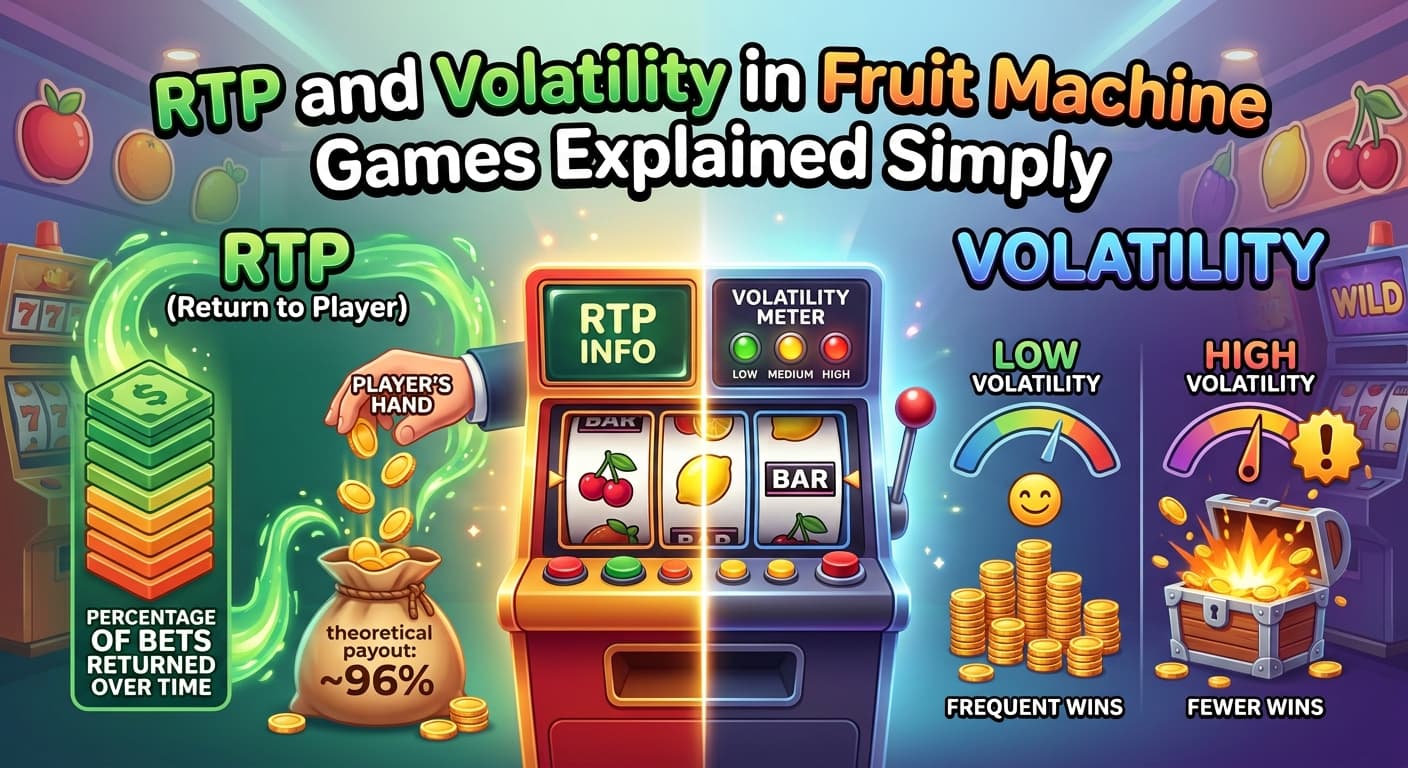

RTP and volatility explained in plain terms - what each number means, why they work independently, and how to use both to pick a fruit machine game that fits your style.
RTP and Volatility in Fruit Machine Games: Why Both Numbers Matter Before You Play
RTP and volatility are two key stats listed on almost every fruit machine game's info screen, yet plenty of players skip right past them. This guide explains what RTP is, what volatility is, and why checking both together - not RTP alone - gives a much clearer picture of what a game is actually like before you start.
Key Takeaways
RTP is the average percentage a game returns over millions of rounds, not a guarantee for any single session.
Volatility comes in low, medium, and high levels, shaping how often a round pays and how large that payout tends to be.
High RTP paired with high volatility usually means rare but large payouts; high RTP paired with low volatility usually means frequent, smaller ones.
The two numbers operate completely independently - checking RTP alone never tells the full story.
Most games display both RTP and volatility on their Game Info or paytable screen.
What Is RTP?
RTP (Return to Player) is the average percentage of everything spun into a game that it's designed to pay back over the long run, calculated from data across millions of spins - it's not a number that predicts any single round's outcome. A game with a 96% RTP, for example, is designed to return an average of 96 units for every 100 units spun through it over time. Any individual session can look very different from that theoretical figure, since it takes an enormous number of rounds before results start converging toward the stated percentage.
What Is Volatility?
Volatility (sometimes called variance) measures how risky a game feels by looking at how often it pays and how large those payouts tend to be. It generally falls into three levels: low volatility, which pays out often but in smaller amounts, suited to players who want to stretch a session out; medium volatility, which balances frequency and payout size; and high volatility, which can go long stretches without paying anything, but occasionally delivers a payout worth hundreds or even thousands of times the spin amount when it does hit.
Some games also list a Hit Frequency figure alongside RTP and volatility, which shows what percentage of spins pay out something at all, however small. Low-volatility games tend to have a high hit frequency, since they pay often, while high-volatility games tend to have a lower hit frequency, since they're built around occasional large payouts rather than constant small ones. Checking this extra figure rounds out the picture of how a game actually plays.
Why Check RTP and Volatility Together
RTP and volatility operate completely independently of each other. Two games sharing the exact same RTP can feel entirely different depending on their volatility. A game with high RTP and high volatility, for instance, usually means results land infrequently but can be large when they do, while a game with the same high RTP but low volatility tends to pay more often in smaller amounts. Even a game advertising a 98% RTP won't pay on most individual spins, since RTP is a long-run average - not a measure of how often any given round pays.
Understanding both numbers together paints a much clearer picture of what to expect from a game, both in terms of the pattern of outcomes you'll encounter and how well that pattern fits your available time and preferred style of play.
Picture two games, A and B, both carrying the same 96% RTP. Game A has low volatility, so players tend to see small payouts fairly regularly throughout a session. Game B has high volatility, so players might see nothing at all for a long stretch before hitting one large payout. Even though both games share the same long-run RTP, the moment-to-moment experience of playing them is completely different - which is exactly why relying on RTP alone tends to lead players to the wrong conclusions about a game.
Beginner Tips for Choosing a Game
Players who want to stretch a session out as long as possible should look for games with low to medium volatility, since these tend to pay more frequently and make the game's pattern easier to follow. Players who enjoy more excitement and don't mind long dry stretches might instead consider a high-volatility game for the occasional chance at a much larger payout. Whichever style fits better, it's worth checking both the RTP and volatility figures on a game's Info or paytable screen before diving in, so the game's underlying structure is clear from the start.
It's also worth setting a clear time limit and budget before playing, especially with high-volatility games where results can go quiet for extended stretches. Understanding a game's structure ahead of time makes it much easier to read what's happening mid-session. Once RTP and volatility click, it becomes easier to explore the structure of other casino games too, such as how to play baccarat or the full poker hand ranking guide, both of which come with their own house-edge and probability concepts worth understanding.
For a deeper explanation of how RTP and volatility work together, Hard Rock Bet covers both mechanics in detail.