
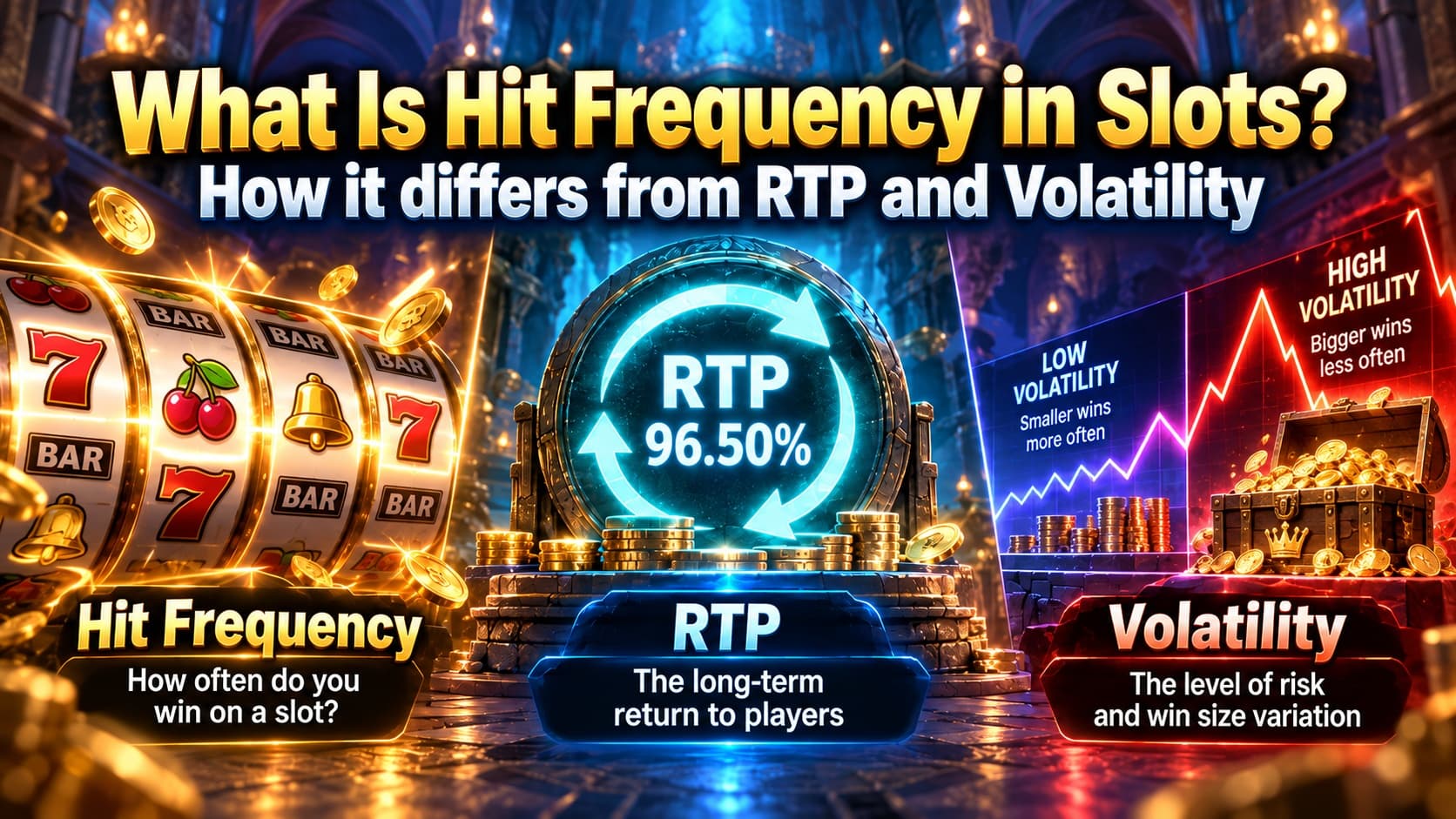
Curious what hit frequency in slots really means? See how it differs from RTP and volatility, with real numbers and a side-by-side example to pick smarter.
Hit frequency in slots is a term that often gets mentioned alongside RTP and volatility, leaving many players unsure how the three actually differ. In simple terms, hit frequency is the share of spins that land any win at all, regardless of size. This guide breaks down all three terms clearly, with real examples throughout.
Key Takeaways
- Hit frequency in slots measures the share of spins that land a win, ignoring payout size.
- The formula is simple: winning spins divided by total spins.
- A game can have high hit frequency and still have a lower RTP than another game.
- Volatility combines hit frequency with payout size into one overall picture.
- Most games fall somewhere between roughly 20% and 45% hit frequency, depending on design.
- One of the most common mix-ups is assuming hit frequency in slots is just another name for RTP
- Picture Game A with a 45% hit frequency but small average payouts, against Game B with only a 20% hit frequency but noticeably larger average payouts
- Hit frequency isn't always listed as clearly as RTP on a game's rules page
How Hit Frequency Is Actually Calculated
The formula behind hit frequency in slots is straightforward: divide the number of winning spins by the total number of spins. If 100 spins produce 20 winning outcomes of any size, that game's hit frequency sits at 20%. This figure comes from simulating hundreds of thousands or millions of spins, so it reflects a long-run average rather than the outcome of any short session.
A game with a hit frequency near 45% means almost half of all spins return some kind of win, even if that win is small enough to barely register against the stake placed on that spin.
Why Hit Frequency Isn't the Same as RTP
One of the most common mix-ups is assuming hit frequency in slots is just another name for RTP. In reality, the two measure completely different things. RTP shows the total share of stakes paid back over the long run, while hit frequency only tracks how often a win happens — it says nothing about how big that win is.
A game can post a 40% hit frequency and still carry a lower RTP than one sitting at just 20%, simply because the first game's wins tend to be small each time, while the second game's rarer wins are large enough to outweigh the difference.
Where Volatility Fits Into the Picture
Volatility is the concept that folds hit frequency and payout size together into one measure. Low-volatility games usually pair a high hit frequency with small payouts, so the balance moves up and down gently. High-volatility games tend to have a lower hit frequency but can deliver much larger payouts when a win does land, so the balance swings more sharply in both directions.
Understanding hit frequency in slots is the starting point for understanding volatility, since it's one of the two core ingredients that shape that broader number.
A Side-by-Side Example
Picture Game A with a 45% hit frequency but small average payouts, against Game B with only a 20% hit frequency but noticeably larger average payouts. A player on Game A sees wins far more often, though the balance may barely move from the starting stake. A player on Game B sees fewer wins, but each one can shift the balance far more noticeably.
This comparison shows that hit frequency in slots is only one piece of the bigger picture — not a single number that decides which game is better on its own. The two profiles line up like this:
| Metric | Game A | Game B |
|---|---|---|
| Hit frequency | About 45% | About 20% |
| Average payout size | Small | Noticeably larger |
| How often wins appear | Frequent | Less frequent |
| Effect on long-run balance | Small swings | Bigger swings |
Where to Actually Find This Number
Hit frequency isn't always listed as clearly as RTP on a game's rules page. Some developers publish it in technical documentation or an official game info sheet, while others leave it out entirely. Without a direct figure, players can get a rough sense of it by watching how often results land during play, though that's far less precise than the theoretical number.
A game's listed volatility rating — low, medium, or high — also gives an indirect hint at its likely hit frequency range.
Using the Number to Pick a Game
Anyone who wants to see wins land often will usually find a higher hit frequency more satisfying. Anyone chasing a larger payout, even if it shows up less often, will likely prefer a lower hit frequency paired with higher volatility instead.
Choosing a game works best when all three numbers are weighed together, rather than looking at hit frequency in slots alone without considering RTP and volatility as well — each number tells a different part of the same story.
Does This Number Change With a Game's Theme
A common question is whether hit frequency in slots depends on a game's theme or graphics. It doesn't, directly — this figure comes from the game's underlying math model set during development, not from whether it's themed around fruit symbols, ancient Egypt, or wildlife.
What actually shapes the number is the paytable structure a developer builds in, along with the matching conditions for each symbol combination, all of which sit behind the graphics a player sees on screen.
A Common Misconception Worth Clearing Up
A frequent misconception is assuming that a higher hit frequency in slots always means a better game than one with a lower figure. In reality, this only makes sense alongside RTP and volatility. A game with a high hit frequency can still carry a lower-than-expected RTP if its individual payouts run too small.
Choosing a good game isn't about leaning on any single number in isolation — reading all three together gives a picture that's much closer to how the game actually plays out.
This is exactly why serious players tend to check a game's full math profile — hit frequency, RTP, and volatility together — before committing a session to it, rather than picking based on theme or graphics alone.
Hit Frequency in Slots in One Paragraph
In short, hit frequency in slots measures how often spins return any win, separate from RTP's long-run payback share and from volatility, which combines both frequency and payout size. Understanding all three together makes it much easier to pick a game that matches your own play style.
Note: this article is for informational purposes only. If play ever starts to feel out of control, support and information are available at BeGambleAware.org.