
TFT What is Wisps TFT Set 18 Open TFT Trend Enchanted Wilds TFT Unreal Engine TFT Blossom Riftbeast Coven
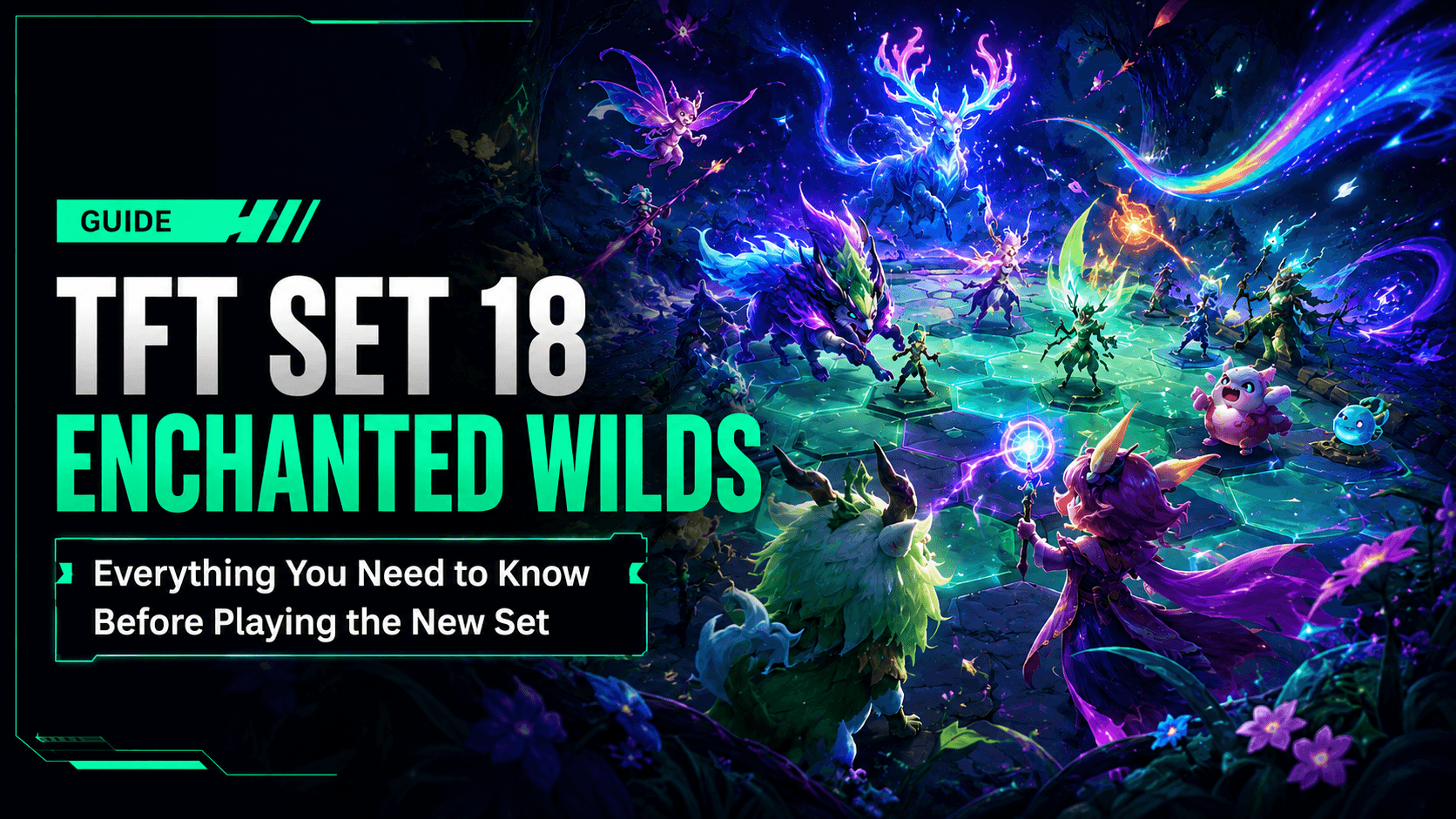
TFT Set 18 Enchanted Wilds is shaping up to be one of the biggest shake-ups Teamfight Tactics has seen in years. It's not just a new roster of traits and champions — it comes with a major engine upgrade and a brand-new system unlike anything the game has had before: Wisps. This article pulls together reviews, breakdowns, and PBE/Pre-Alpha gameplay footage from several sources into one complete guide, covering the theme, release timeline, new systems, standout traits, and the best comps to run from the early game onward.
Theme and Release Timeline
The set's theme is the "Enchanted Wilds" — a mysterious forest packed with creatures and natural magic. What sets this set apart from previous ones is the switch to Unreal Engine, which noticeably improves graphics and board environments (biomes), and more importantly, lets the board itself change shape based on player actions. Certain champions can literally plant seeds that turn parts of the board into forest or water.
As for release timing, the set entered the PBE test server around July 28, 2026, followed by the full live server rollout (including the Thai server) in late August 2026. Players wanting to try the new systems early should keep an eye on the PBE window, since many of the strong comps covered in this guide were pulled directly from that testing period.
What Are TFT Wisps? The New Gold-Management System
One of the most talked-about additions in Enchanted Wilds is the Wisps system, which builds on the Charms mechanic from Set 12. Wisps appear in the rightmost slot of the shop, cost gold to purchase, and offer a wide range of effects split into two categories:
- Combat/buff-focused: stunning enemies, converting an item into a Radiant version, or granting stat boosts.
- Economy/leveling-focused: converting gold into XP, gambling on quests for rewards, or even summoning a 5-cost champion outright.
What makes Wisps interesting is that they only appear during the Planning Phase, forcing players to manage gold carefully and commit to purchases — rerolling the shop changes the available Wisps too, so you can't hold onto the same options indefinitely. This system essentially fills the role that dedicated economy traits used to play in past sets, like Primordian or Timebreaker, which this set doesn't have.
Gameplay footage has shown Wisps that drop single-use "potions," such as a healing potion for when your HP is low, letting players swing the outcome of a single fight. Others let you roll dice for gold based on the result, or split gold between you and an opponent simultaneously — turning every Wisp purchase into a real strategic decision that can shape the whole game.
The Lux (Avatar) Special Champion System
Another returning mechanic, originally from Set 2, is the Lux (Avatar) system. Lux appears in the shop paired with a randomly assigned trait — for example, Blossom Lux or Elderwood Lux. Whichever trait she's paired with when purchased, she grants +2 to that trait immediately and can use that trait's skill as well. Only one Lux trait variant appears to be available per board at a time, and other players can't buy the same copy — making her a unique, powerful trait booster that's different in every game.
New Traits in Enchanted Wilds
The traits (Origins) in this set are far more varied and unconventional than in past sets. Here are the standout ones players are talking about most, including the trio of Blossom, Rift Beast, and Coven, each of which plays in a completely different way.
- Rift Beast: This trait turns League of Legends' jungle monsters into playable champions — Wolf, Raptor, Scuttle Crab, all the way up to the Elder Dragon. Its key feature: once you hit 5 Rift Beast units, the shop starts filling up with more Rift Beast champions on its own, making it easy to hit 2- and 3-stars without spending much gold rerolling.
- Blossom: This trait directly combos with the Wisps system — the more Blossom units you run, the more the Wisps in your shop upgrade. For example, a dice-roll Wisp becomes a double roll, or a Wisp that splits gold with an opponent gives you a bigger share. It's ideal for players who want to lean on Wisps as their main economy engine.
- Coven: This set's "lose to win" comp. It banks soul points from both kills and losses, which can then be traded in for special rewards.
- Eldritch: Adds a special tile to the board — any champion standing on it gets "sacrificed" in exchange for a large buff to the rest of the team.
- Inferno: Beyond burning enemies and reducing healing, running enough Inferno spreads fire to the shop itself, raising upgrade costs for opponents.
- Elderwood: Summons trees/golems onto the board, which upgrade into 2- or 3-star versions the more Elderwood units you run — and can even be sacrificed in place of real units for the Eldritch trait.
- Solar & Lunar: Solar focuses on shields and spell-power bonuses, and at its highest threshold can even upgrade 3-star units into 4-star units. Lunar instead buffs attack speed and spell power for nearby allies.
Classes and Standout Unique Champions
Several returning classes are back, including Brawler, Defender, Hunter, Invoker, and Juggernaut. More interesting are the new classes: Adapter, whose stats shift based on whichever is higher, AD or AP (found on champions like Kog'Maw, Nidalee, and Master Yi), giving a lot of build flexibility, and Sprikin, whose gimmick lets a champion ride piggyback on Willump for bonus stats.
There are also several champions with genuinely unique mechanics worth noting — Ivern (Green Father), who plants seeds that reshape the board's biome and best showcases what Unreal Engine can do; Draven (Bounty Hunter), who hands out quests for rewards on completion; and Taric (Emerald Aspect), who can "bond" with one ally to share buffs together.
Best Early-Game Comps in TFT Set 18
One key difference in this set is that there is no direct economy trait like previous sets had, so gaining an early advantage relies on other mechanics instead — mainly upgrading the Wisp system or using specific units that generate gold and champions on their own. The general early-board principle is to run 2 tanks and 2 damage dealers for balance, and to prioritize giving items to your strongest 2-star unit first, rather than forcing every trait bonus regardless of fit. You don't need to hit every synergy — sometimes a strong standalone unit, or one that directly supports your main carry, is better than chasing a trait bonus that isn't useful yet.
The most commonly recommended early comps are:
Ravager (melee damage): Uses Akali and Camille, both 1-cost units, as carriers for physical damage items like Infinity Edge or Hand of Justice, backed by a frontliner like Shen (who also pairs with Akali for the Inferno trait). Late game, this comp transitions easily into stronger 3–4 cost physical damage dealers.
Xayah (ranged/rapid attack): Pairs backline Xayah with Rapid Fire class items like Guinsoo's Rageblade or Kraken Slayer, backed by a thick frontline of tanks to buy her time to ramp up attack speed. Late game, items can shift to Aphelios or Draven, who share the Rapid Fire trait.
Blossom (spellcaster + economy): Built around Karma and Ahri, who are both Blossom and Spellweaver. The Blossom trait upgrades Wisps in the shop, increasing the odds of pulling economy-focused Wisps to fund early gold. This comp can scale into either a full Blossom 7 board or a dedicated Spellweaver lineup.
Rift Beast (jungle-to-riches): The goal is to hit the 5-unit Rift Beast breakpoint as fast as possible, since the shop then starts filling with Rift Beast units on its own, letting you hit 2- and 3-stars with minimal rerolling by Stage 3. Late game, you can push levels to add the Elder Dragon and reach 10 Rift Beast for a strong closing board.
Solar (reroll comp): This trait is very weak early on, since its power scales entirely with the number of 3-star units on the board. The recommended approach is to intentionally lose to bank gold via a loss streak, then roll down all at once to hit Kayle and the rest of your board at 3-star simultaneously.
Sprikin: Built around Veigar, Kobuko, and Rek'sai, this trait grants bonus stats to whichever unit rides piggyback on a teammate — effectively a free half-to-full item. The longer a fight drags on, the more value it generates. It also pairs well with Elderwood, since summoned trees can be sacrificed in place of real units for Eldritch's buff without losing combat power.
Rengar solo-carry: If Rengar (a 3-cost unit) shows up early, pick him up immediately. He hits hard, has built-in lifesteal, and generates his own gold every 8 takedowns. The playstyle here ignores synergy entirely — just stack as many tanks as possible to buy him time while he slowly picks off enemies and funds a push toward Fast 9.
For a general Fast 9 approach, the recommendation is to grab Rengar, Teemo, or Leblanc early to accelerate resource gain — Leblanc in particular has a skill that copies champions already on your board, saving significant gold when hunting for key units.
The Strongest Comps From PBE Testing
PBE testing surfaced several standout comps. Qiyana Reroll is a spellcaster/Executioner build that doesn't need Infinity Edge since the trait already provides built-in crit; Tristana Reroll is a Fay rapid-attack build that relies heavily on Hextech Gunblade to convert team healing into bonus damage; Kog'Maw Adapter flexes between AD and AP depending on itemization; Aphelios & Brambleback is a level-8 AD board built around Kraken Slayer and Last Whisper; Soraka 4 Blackthorn is a level-8 spellcaster board using Maokai as the main tank; and Fast 9 Elder Dragon and Draven combos with Rift Beast buffs to unlock an Execute bonus that instantly kills low-HP enemies.
There's also footage from high-Elo internal testers showcasing the raw power of a full Solar + Elderwood reroll comp. Once you hit the trait's max threshold of 8 three-star units, every 3-star unit on the board gets promoted to 4-star for that combat round. In the footage, a 4-star Kayle unleashes devastating waves of light damage across the board, while Leblanc is used to help pump out 3-star units faster without wasting gold on rerolls. Even when facing off against an opponent running a Rift Beast comp with an Elder Dragon, the fully-stacked 4-star Solar board still came out on top.
Final Verdict Is Enchanted Wilds Worth Getting Into?
Overall, TFT Set 18 Enchanted Wilds is a clear departure from previous sets — the switch to Unreal Engine genuinely lets the board change shape, the new Wisps system replaces the traditional economy trait, and the new traits all play in wildly different, non-overlapping ways. Whether it's farming jungle monsters with Rift Beast, sacrificing allies with Eldritch, or losing your way to victory with Coven, there's a lot more variety in how each game can be planned out compared to past sets.
For anyone waiting on this set, the PBE window in late July 2026 is worth watching closely if you want to test things out ahead of the full launch, and getting familiar early with strong comps like Solar+Elderwood Reroll or Rift Beast Fast 9 will help you adapt to the new meta faster once the set goes fully live.