
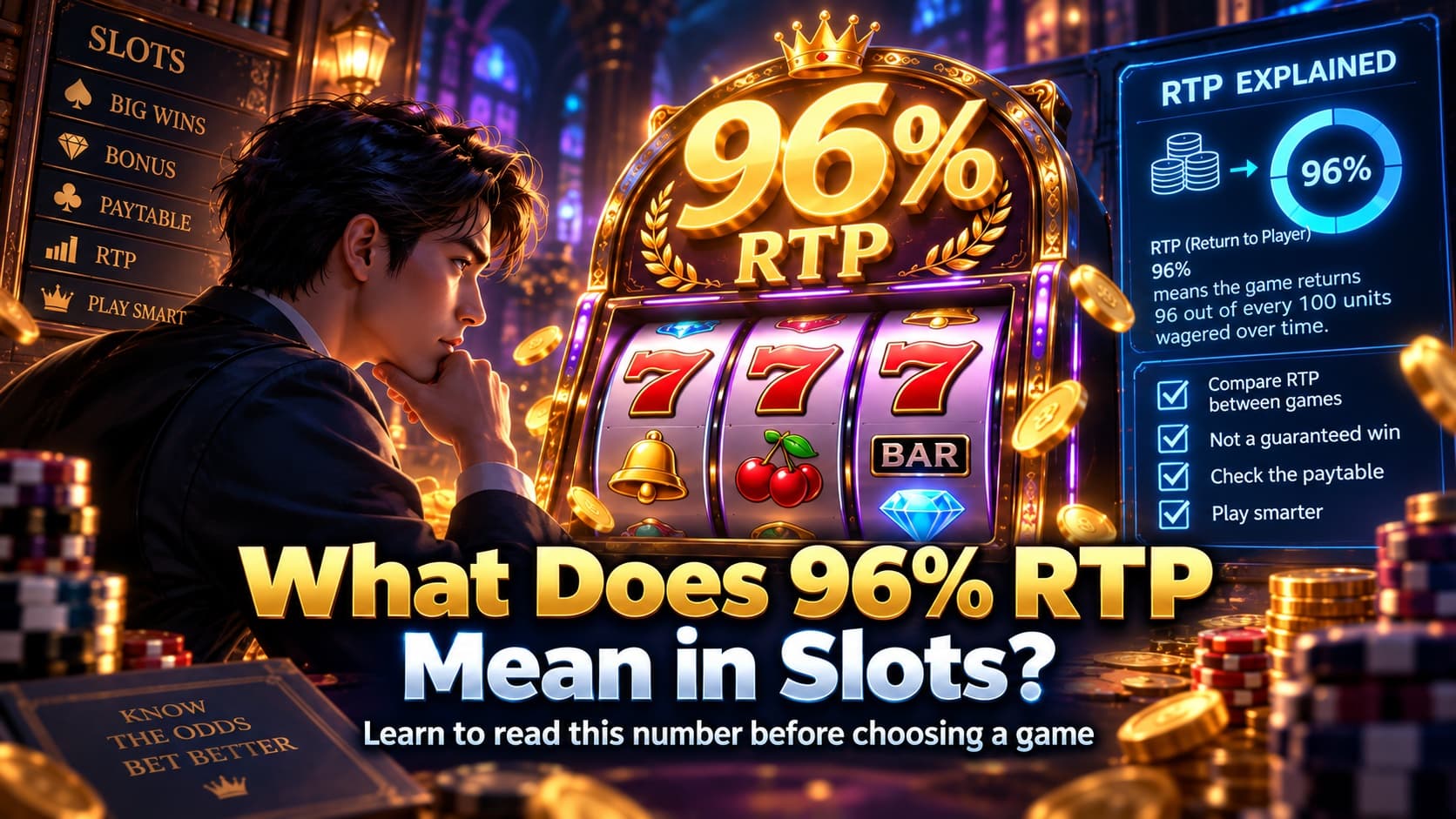

What does RTP 96% mean in a slot game? Learn where this figure comes from, how it's calculated, and how to read it correctly before choosing a game to play.
Many players see the number RTP 96% on a game's info page but aren't sure what it actually means. A common question is what RTP 96% means in a slot game, and how this number relates to any individual player's results. This article explains where this figure comes from, how it's calculated in simple terms, and what to watch out for when interpreting it, so you can read RTP correctly before deciding on a game.
Key Takeaways
- RTP 96% means the game is theoretically designed to pay back an average of 96 units for every 100 units wagered.
- This figure is calculated from millions of rounds of play, not the outcome of a single session.
- RTP 96% is a long-term average, not a guarantee of any individual player's results.
- The remaining 4% is the portion the operator retains as its operating margin.
- RTP should be read alongside volatility to get a complete picture of a game.
Where Does the RTP 96% Figure Come From
Many people want to know whether RTP 96% is a number operators set randomly or one that comes from an actual calculation. The answer is that it comes from calculation. RTP 96% is a figure derived from the mathematical structure of the game, simulated across millions of rounds to find the average ratio of what the system pays back versus what is wagered in total. This figure is set from the game design stage and is tested by relevant regulatory bodies before the game is released for real play — so it's a value with a calculated basis, not one set arbitrarily.
A Simple Example of How RTP 96% Works
Imagine spinning a game with a total of 100 stake units over a very long period. A game with 96% RTP is designed so that the sum of payouts averages around 96 units, with the remaining 4 units being the margin the system retains. This is purely a long-term theoretical overview — actual play on any given occasion can produce results far above or below this average. The more rounds included in the calculation, the closer the average result gets to the stated RTP figure. Conversely, calculating from just a few dozen rounds can produce an average that deviates significantly from the theoretical figure.
Why RTP 96% Is Considered a Common Industry Standard
An RTP of around 96% is a level commonly found across most games in today's online gaming industry. Some games may sit slightly lower, while others may reach as high as 97–98%, depending on the developer. Because this figure is similar across many games, players can use RTP as a convenient baseline for comparing different games.
What to Watch Out for With High or Low RTP Figures
One important precaution: don't assume a higher RTP always means better short-term results, since this figure only reflects the long-term overview. A game with high RTP but also high volatility may deliver a more volatile experience than a game with slightly lower RTP but low volatility. Deciding which game to play shouldn't rely on RTP alone without considering other factors.
The Relationship Between RTP and Short-Term Results
RTP doesn't tell you what the outcome of your next spin will be, since each round is an independent event not tied to the one before it. The 96% average only becomes clearly evident once the number of rounds reaches into the millions. Playing for a day or a week is far too small a sample to accurately reflect the true RTP figure.
How to Check RTP Before You Start Playing
Before playing, always check the rules page or the game's info page, which usually states the RTP clearly. If this information isn't shown directly in the game, you can check the official information published by the game developer. Checking beforehand gives you an overview of the game in advance and makes it easier to compare against other games.
Using RTP Rationally to Inform Your Game Choice
RTP should be treated as supporting information for a decision, not the sole deciding factor. It should be considered together with the volatility level and your prepared budget to choose the game that best suits your playing style. Having complete information reduces the chance of a poor decision based on understanding just one side of the number.
RTP 96% in Slots Is a Value You Can Compare Between Games
Once you understand that RTP 96% is a theoretical average with a clear basis, you can use this figure to compare between different games more conveniently before deciding. For example, one game has 96% RTP while another has 97% — the higher figure reflects a game structure designed to pay back a theoretically larger proportion in the long run. However, it should always be considered together with volatility, since RTP alone doesn't tell the whole story of the playing experience.
Frequently Asked Questions About RTP 96% in Slots
Many people ask whether every game with 96% RTP delivers the same results. The answer is not necessarily, because even though RTP 96% represents an equal average, the volatility level of each game can vary greatly, resulting in different payout patterns. Another common question is whether you should trust the RTP figure displayed in a game. The answer is yes, since it's a value that has gone through calculation and standard verification before being published.
Conclusion
RTP 96% in slots is a theoretical average that indicates a game's long-term payback ratio across a massive number of rounds — not a figure that guarantees the outcome of any single play session. Understanding the origin and limitations of this figure helps you read game information correctly and use it to make more rational game choices.
Note: This article is intended for informational and educational purposes regarding game mechanics only. It is not intended to encourage play or guarantee any outcome. If you feel your gaming is becoming difficult to control, further information and support are available at BeGambleAware.org.